
Horse Things I Learned during the Year of Covid
As 2020 draws to a close, I find myself reflecting on how my relationship with my horse Larry has changed during the Year of Covid.
Early on was the Covid lockdown, which resulted in closure of Larry’s barn until we could all come to grips with what was happening, and figure out a way forward. When I was finally able to visit Larry, the barn and arena were off-limits, so my first encounter with him was in a paddock on a cold spring day. The little charmer took one look at me, pinned his ears and walked away. His thought bubble was very clear: ““You are NOT riding me. I LIKE being a lawn ornament!” The fact that he was just finishing three months of time off probably contributed to his attitude. Happily, a few carrots won him back.
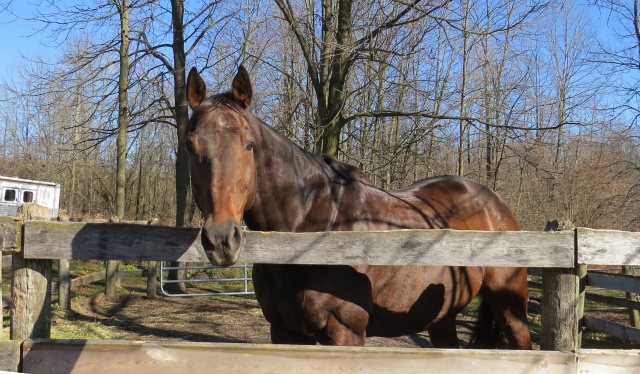
Before the Year of Covid, I didn’t know much about stomach ulcers in horses. I learned fast when Larry went on a 5-day course of Bute to help diagnose his unwillingness to trot or even to walk for very long.
For my non-horse friends, Phenylbutazone is an anti-inflammatory drug that is very good at blocking pain. If Larry’s unwillingness to trot was due to pain, then Bute would block it and he would then be happy to move. The downside of Bute is that it has a narrow margin of safety and in some horses can produce toxic effects, including ulcers of the gastrointestinal tract.
It turned out that Larry was one of those horses. On Day 1 he was definitely happier about trotting. But after that, he began to exhibit signs of significant pain. He’d stand in the cross-ties with his ears pointed backwards and his eyes half-closed. His chin looked tight. When I groomed him, he lashed his tail and pinned his ears. Manual palpation of certain acupuncture points strongly suggested ulcers.
After a course of Omeprazole, the drug of choice for curing stomach ulcers, Larry was a new horse, brighter and happier. However, the whole experience made me wonder if I’d been missing minor signs of ulcers before this. A quick look at the scientific literature revealed a prevalence of equine gastric ulcers in performance horses ranging from 40% to 90%. In one post-mortem study of retired race horses, 52% were found to have ulcer lesions. The chances seemed pretty good that Larry might have been suffering from low-grade, chronic ulcers even before the Bute. So I started him on an herbal product that would treat both gastric and hindgut ulcers. Both “Jeremiah’s Ulcer RepulserTM” and “Mad Barn Visceral +” have worked well. He’s definitely been less cranky, and the ulcer herbs are now a permanent part of his supplement list.
Another change this year has been the startling realization that my hands can feel areas of tension in Larry’s body. And that I can knead and press and massage those areas to release the tension. It’s been a pleasant surprise to see Larry yawning, licking and blinking his eyes when I perform my blundering ministrations. These are the same signs his bodyworker uses to tell her that her interventions are working.
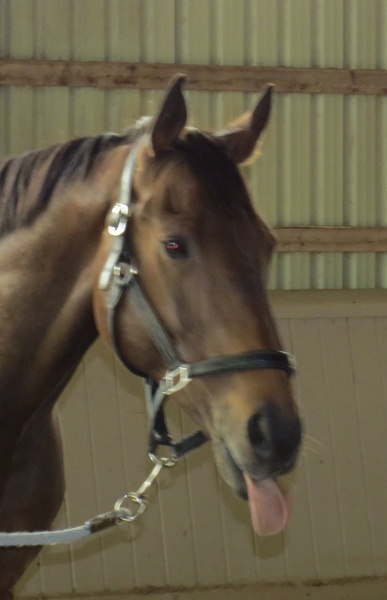
I’ve developed a stronger connection with Larry this year. One recent day when I was lungeing him, he yanked the lunge line out of my hands and went careening around the arena at a racehorse gallop. I’ve learned there’s no point trying to stop him. Even wringing my hands is a waste of time. So I stood where I was and watched. At one point he angled across the arena towards me at a full gallop. In case he hadn’t seen me, I waggled a stern finger at him. He swerved away. It gave me a ludicrous feeling of power, as if I’d just mastered the “Expeliamus!” move at Hogwarts. It seems my secret power also convinced him to walk back and nuzzle me when he was finished running.
Covid Year has been a tough one on many levels, but it has also taught me always to look for the silver lining. It’s always there. Because I haven’t been able to do much riding, I’ve discovered new ways to interact with Larry. I’ve become better at reading his body language and his facial expressions. I’ve learned more about his aches and pains, and found ways to keep him comfortable and happy. And I’ve begun learning to influence him in ways that don’t involve a saddle.
In 2021, with the Year of Covid behind us, I’m going to look forward to new discoveries about Larry and about myself. I hope that you, too, can look forward to a year of silver linings and happy horses!
2 thoughts on “Horse Things I Learned during the Year of Covid”
Hi Louise,
Happy New Year, by the way…I love this blog. A dog trainer friend/chiropractor, who also is trained to work with animals, recently taught me how to adjust my dogs’ spines (working retrievers and border collies are especially susceptible to “rucking” in their lower spine). Ellie’s entire demeanour changes when you release the trigger points. There’s a noticeable flinch, then relaxation.
It’s wonderful that we’re learning to be aware of our animals’ discomfort and ways to help them!